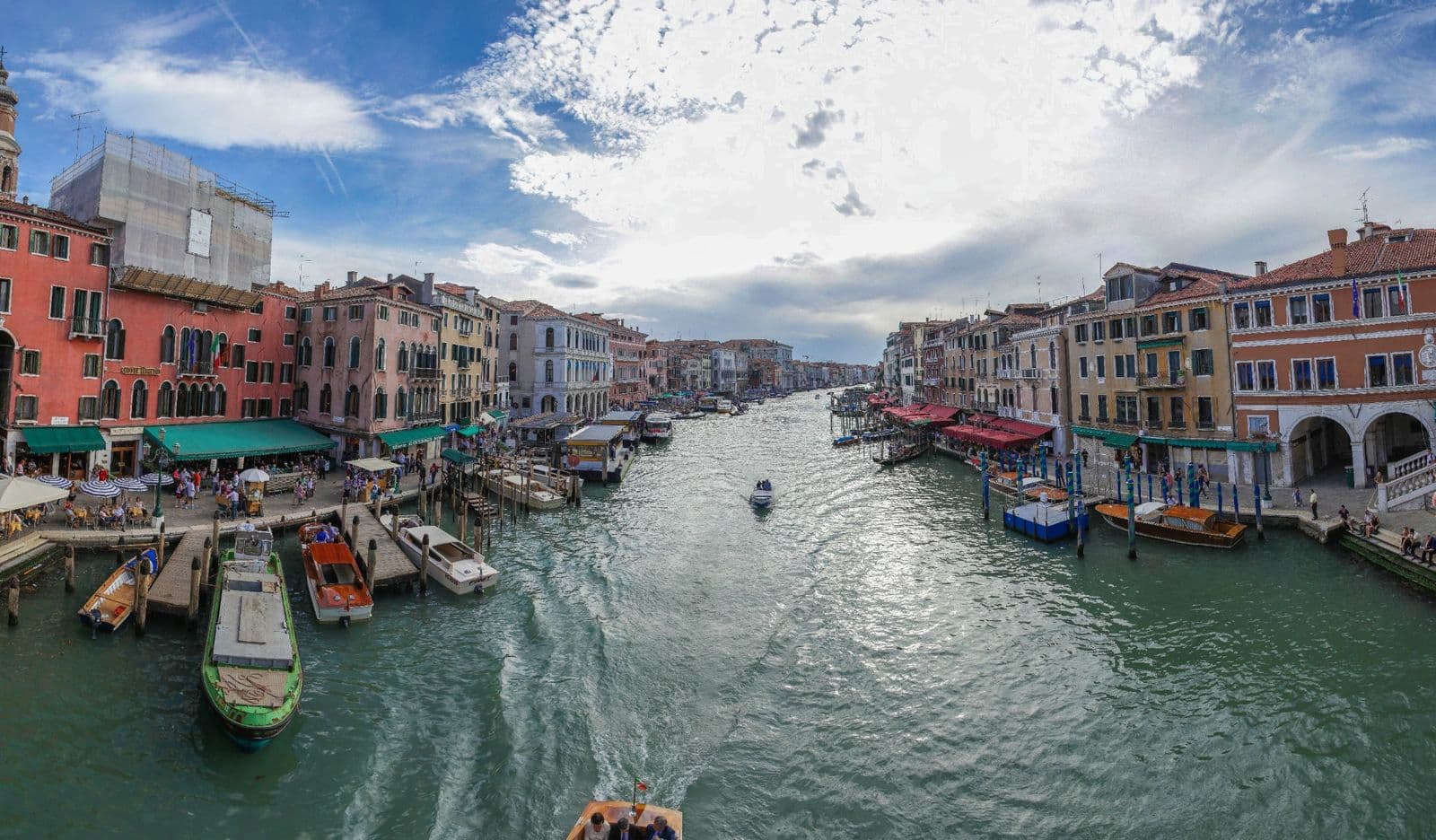
Venice, Italy
Quick port decision
Can I DIY?
Conditional
Moderate on your own
Main attraction
Piazza San Marco and the historic centre
Getting from the ship
Transport needed
Public transport: Limited
Return risk
High
Mainland transfer, and acqua alta disruption in winter
Top sights
Ancient History & Ruins
St Mark's Basilica
On Piazza San Marco. Ticketing is tiered — basilica, Pala d'Oro, museum and Loggia dei Cavalli, and the Campanile are separately priced — and advance booking is the official site's primary instruction.
Ancient History & Ruins
Doge's Palace (Palazzo Ducale)
Adjacent to the Basilica, open 09:00-19:00. Standard tickets do not require a fixed entry slot, contrary to much third-party advice, but the Secret Itineraries tour is by reservation only and capped.
Beautiful Scenery
The historic centre on foot
The reason to come, and free. Bear in mind it is a city of bridges and steps — Venice's official accessibility pages describe barrier-free itineraries rather than claiming the centre is step-free.
DIY vs. excursion
Can I DIY this?
Conditional
Getting around
Moderate
Excursion
Helpful
Once you reach the historic centre it is entirely a walking city and no tour is needed. The uncertainty is the transfer, not the destination — and which transfer you face is set by your ship's size, not by anything you can book.
More details
Decree-Law 103/2021 bans ships over 25,000 gross tons from transiting the San Marco Basin, the San Marco Canal and the Giudecca Canal, and the government's Cruise Commissioner confirms it is still in force. Ships under that threshold can still use Stazione Marittima or San Basilio, inside the city. Everything larger enters through the Malamocco inlet to Porto Marghera (the Liguria and Lombardia quays, both designated temporary cruise berths by ordinance) or to the Fusina terminal, which opened in 2024 — all on the industrial mainland. Small ships also use Chioggia, a separate port south of the lagoon. Note too that check-in and the berth are not always the same place: MSC states that embarkation formalities happen at Stazione Marittima and guests are then transferred to Marghera to board. Confirm your own line's arrangement rather than assuming.
Return risk
High
Main risk
Mainland transfer, and acqua alta disruption in winter
From Marghera or Fusina the return is a road or water transfer measured in tens of minutes on top of getting out of the historic centre, and Crystal's own guidance notes the Fusina ferry runs only hourly. Between October and March a high tide can suspend the vaporetto services you were relying on. No official source publishes a recommended buffer for any Venice berth, which is itself the reason to leave a large one.
Getting from the ship
To Piazza San Marco and the historic centre
Public transport: Limited
Tender port: No
Exploring Venice, Italy
Best case
Stazione Marittima / San Basilio (ships under 25,000 GT)
Inside the city. Marittima is served by the People Mover, an 822 m elevated shuttle to Piazzale Roma costing €1.50 one way, and from there you are on the vaporetto network or on foot. San Basilio sits on the Giudecca Canal with a vaporetto stop beside it.
Budget the transfer
Porto Marghera — Liguria or Lombardia quay (ships 25,000 GT and over)
Industrial mainland, reached through the Malamocco inlet. MSC runs its own boat between Marghera and San Marco for guests on its excursions, quoting about 45 minutes each way. No official source describes a general shuttle for independent passengers, so ask your line what it provides before planning a day.
Plan the return carefully
Fusina
Crystal, which homeports here, describes Fusina as roughly three miles from the city and about half an hour by road, with an hourly ACTV Line 16 ferry to Zattere taking around 30 minutes — and warns that the ferry stop is some distance from the cruise terminal itself.
A different place, not a suburb
Chioggia
A separate port south of the lagoon, used by small ships and growing — the port authority reports 23 cruise calls there for 2026. Neither the port authority nor the town publishes any transfer method, distance or time to the Venice historic centre, so treat a Venice day from Chioggia as unplanned until your line tells you otherwise.
Practical notes
Recommended visit duration
Judge it backwards from your berth: from Marittima a half day works, from Marghera or Fusina assume an hour of transfer each way before you have seen anything
Accessibility
Venice publishes barrier-free itineraries, disability transport concessions and wheelchair hire through its official Accessible Venice service rather than describing the centre as step-free — the city is built on bridges and steps. The Doge's Palace states it has lifts and accessibility services.
Weather
Acqua alta season runs October to March. It matters because the transport degrades before the pavements do: ACTV suspends or reroutes specific San Marco services from 85 cm, and suspends the waterborne network as a whole above 140 cm. A high tide can remove the route you planned to return by.
Crowds
Cruise volumes are well below the pre-ban peak and the fleet has shifted to smaller luxury ships, so cruise-driven crowding is lower than its reputation — but Venice's own year-round visitor pressure is unchanged.
Worth booking ahead?
Yes
Cruises calling here
11 routes in Galythia's catalogue include Venice, Italy.
Costa Deliziosa
7 nights · Mediterranean
from Venice
MSC Armonia
7 nights · Mediterranean
from Split
MSC Armonia
7 nights · Mediterranean
from Venice
MSC Lirica
7 nights · Mediterranean
from Venice
Viking Mars
9 nights · Eastern Mediterranean
from Venice (Chioggia), Italy
MSC Lirica
11 nights · Mediterranean
from Venice
Silver Spirit
12 nights · Mediterranean
from Civitavecchia
Costa Deliziosa
14 nights · Mediterranean
from Venice
Star Explorer
15 nights · Mediterranean
from Barcelona
Seabourn Ovation
29 nights · Mediterranean
from Dubrovnik
Seabourn Ovation
37 nights · Mediterranean
from Dubrovnik
Image credits
Photo: Grand Parc - Bordeaux, France / Wikimedia Commons · CC BY 2.0 · resized and compressed · CC BY 2.0